Posts

Showing posts with the label Christian Education

Helping Students Pay Attention to "New Creation"

Each new academic year, approximately 20 million students will attend college in the United States. The demographics reveal that these students are as diverse as they have ever been. And yet, even though these 20 million students bring with them as many different perspectives, backgrounds, and experiences, they nevertheless all share one thing in common: they all come to college to find their place in this world. This quest to find one’s place in the world comes in the form of a number of different questions that students ask as they step onto the college campus: Who am I? Why am I here? What is the point of life? Is there a point to life? Do I belong? Where do I belong here? Who are my people? What am I going to do for a living? Who will I marry? (Will I ever marry?) Who will my friends be? (Will I make any friends?). In other words, each year students come on to our campus seeking to discern three inter-related themes: identity, purpose, and belonging. This is part of what makes the...
What Do We Study the Bible for? An Introduction to KOINONIA.

What Do We Study the Bible for? An Introduction Why do we study the Book of Revelation (or any other biblical studies course offered in our curriculum)? What is knowledge of the book for ? What should we seek to get out of engaging with Scripture? How we respond to these questions will depend, in part, on the vantage point from which we read Revelation (or any other biblical text). If you consider yourself to be a follower of Jesus, the life you have been called to is a life in which you have been invited to receive and enjoy God's love and in which you have been called upon to faithfully participate in God's life of love for the sake of the church and the world. And that reality undergirds, shapes, and animates how we read the Bible. We catch a glimpse of this life we have been invited into in what is perhaps an unexpected place, the prayer life of Jesus. Prayer is often where we find one's deepest expressions of want, longing, and desire, where we learn what matters most...

How Corporate Worship Shapes Us

When we gather on Sundays, we rehearse a way of life together--we embody a foretaste of our one hope. Each Sunday we practice (in the double sense of that word) this way of life together in our liturgy, with the hope that our corporate worship not only glorifies God and coheres with our profession, but that it also forms us to be the people that God calls us to be. In other words, our Sunday worship trains us for everyday life, in the same way that what you practice, the habits and skills you develop through conditioning, drills, or scales will play out on the field, or the court, or the keyboard, or the guitar strings. And so, each Sunday we practice the practices that are generated from the revelation of God--Father, Son, and Holy Spirit:  we start each morning by acknowledging that God is already at work in our lives; with our prayer of invocation we say, “Lord, help us to be what you have called us to be”; we hear afresh His call to exclusive worship--for His glory and our good...

Learning what it means to be human in a living world: Wendell Berry's vision for Higher Education

 Our system of education has one major: Upward Mobility.  This is the bold claim that Wendell Berry makes in a commencement address he gave in 2009 (in the midst of the Great Recession) to Northern Kentucky University graduates. His address, entitled "Major in  Homecoming", underscores the devastating effects that this form of education has had on people and the land they live on: for upward mobility also implies downward mobility; and it has proven to generate social instability, ecological oblivion, and economic insecurity.  Education, Berry laments,  has been reduced to job training and preparation for serving corporations whose only concerns are efficiency and the maximizing of profit. Pointing to the crushing reality that most of the graduates attending the commencement were coming to terms with in the midst of the Great Recession, Berry charges that the failure of the economy and its subservient institutions has become so obvious that it cannot now be deni...

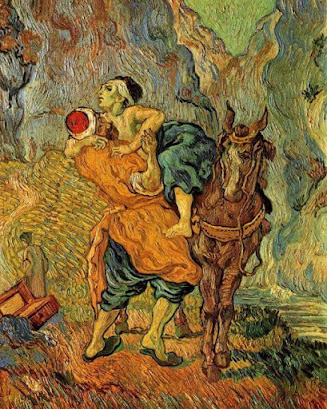
What must we do? The Good Samaritan as a window into understanding Christian vocation

Image
Many have heard the term "Good Samaritan". It is often used in our contemporary culture to describe a helpful person, someone who goes out of her own way to meet another's dire need.  The story of the "Good Samaritan" only occurs in the Gospel of Luke. And it's actually (more accurately) a story about an encounter between Jesus and a religious scholar (Luke 10.25-37).  The good Samaritan makes an appearance in this encounter as the means by which Jesus responds to the religious scholar’s question about neighbor love.  In order to hear this story afresh, this encounter between Jesus and the legal scholar, it is helpful to know that it falls within a larger literary context (Luke 9.52-19.48) sometimes referred to as the "journey section". In this larger portion of the Gospel, Luke highlights Jesus' approach to Jerusalem, where his confrontation with religious and political leaders will come to a climax, where he will be considered an outsider...